
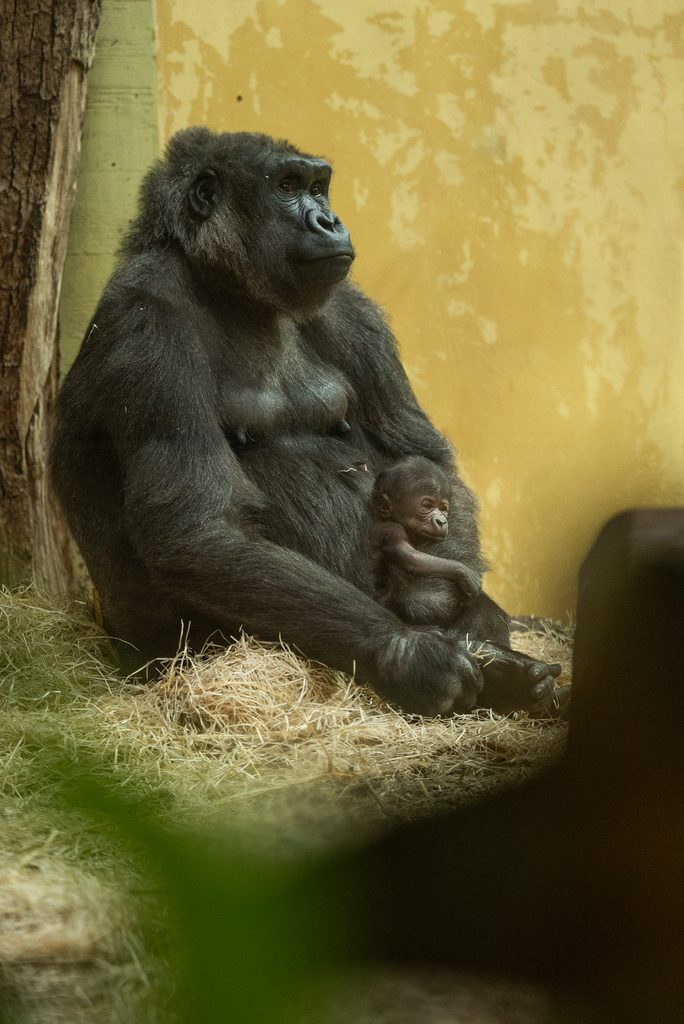
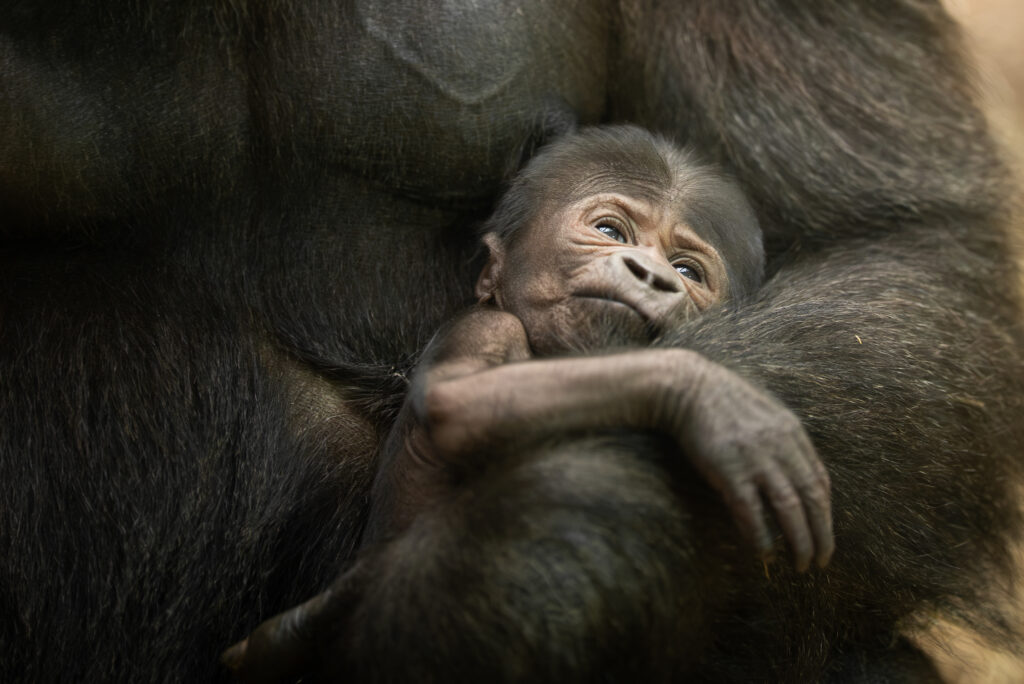
Zurich Zoo has welcomed its second western lowland gorilla (Gorilla gorilla gorilla) infant in four months. On Sunday, 22 November, female gorilla Haiba gave birth to her first offspring, a male named Asakana.
The birth took place without complications and in the presence of the entire gorilla group.
Like Mayumi, who became a mother for the first time in late July, Haiba has already demonstrated attentive and protective maternal behaviour. She keeps her infant close, limiting physical contact with other members of the group, including his father, Bwana.
The animal care team has already observed the infant nursing.
Two births reflect positive group development
Zurich Zoo’s gorilla group was restructured last year, following the arrival of a new silverback and three females. Haiba was the only female from the previous group to join the new social structure.
Gorilla groups are not fixed social units, either in the wild or in zoological institutions. The arrival or loss of individuals can lead to changes in relationships and social hierarchies, sometimes involving periods of tension.
According to Zurich Zoo, the two recent births are an encouraging indication of the group’s developing stability.
“We are delighted about the second birth among our gorillas. It is wonderful to see how the gorilla group, which has been living together for a year, is growing and developing,” said Zurich Zoo Director Severin Dressen.
He emphasised that a well-functioning social group and successful reproduction can contribute to the conservation of western lowland gorillas through the One Plan Approach.
Despite the positive developments, Dressen also stressed the importance of remaining realistic. The first weeks of life are particularly delicate, and several months will pass before the two infants become playmates and begin exploring the group more independently.
A close mother-infant bond remains essential for gorillas for many years.
The births are also significant from an animal welfare perspective. Gorillas are highly social animals that invest considerable time and effort in caring for their offspring. The presence of infants can enrich the daily lives and social dynamics of the entire group.
All gorillas at Zurich Zoo are part of the EAZA Ex situ Programme (EEP), contributing to the stability of the conservation population under human care.
Amata and Asakana: two names connecting Zurich with the Congo
Both gorilla infants have been given names originating from Lingala, a language spoken in the Republic of the Congo.
The choice reflects Zurich Zoo’s commitment to connecting conservation under human care with the protection of species in their natural habitats.
Since 2025, Zurich Zoo has been working with the Wildlife Conservation Society Congo (WCS) on a conservation project in Nouabalé-Ndoki National Park, in the Republic of the Congo.
Covering more than 4,000 square kilometres of the Congo Basin, the protected area contains largely undisturbed tropical rainforest and represents one of the most important refuges for western lowland gorillas.
A new forest habitat for Zurich Zoo’s gorillas
The connection with Central Africa will also be reflected in the zoo’s planned Ndoki Forest habitat, which will be developed in the lower section of the zoological park.
The project will feature an open, swampy clearing surrounded by dense forest, with approximately 100 large trees reaching heights of up to 25 metres.
The new habitat will provide natural climbing opportunities for the gorillas while allowing visitors to discover Central African ecosystems and learn about the importance of protecting them.
Western lowland gorillas face multiple threats in the wild
The western lowland gorilla is classified as Critically Endangered (CR) on the IUCN Red List of Threatened Species.
According to figures provided by Zurich Zoo, wild populations are currently declining by approximately 2.7% annually.
The subspecies’ natural range extends across several Central African countries, including Cameroon, Gabon, the Republic of the Congo and the Democratic Republic of the Congo.
Major threats include poaching, hunting for bushmeat, deforestation and habitat loss. Political instability and armed conflicts further undermine conservation efforts, while Ebola outbreaks can devastate entire local populations.
“Connecting nature conservation, species conservation, education and research is a holistic approach to protecting threatened species,” Dressen concluded.
“Two gorilla infants are therefore much more than new arrivals at the zoo. They represent a visible and important contribution to our efforts to protect western lowland gorillas and their habitat in the Central African Congo Basin.”