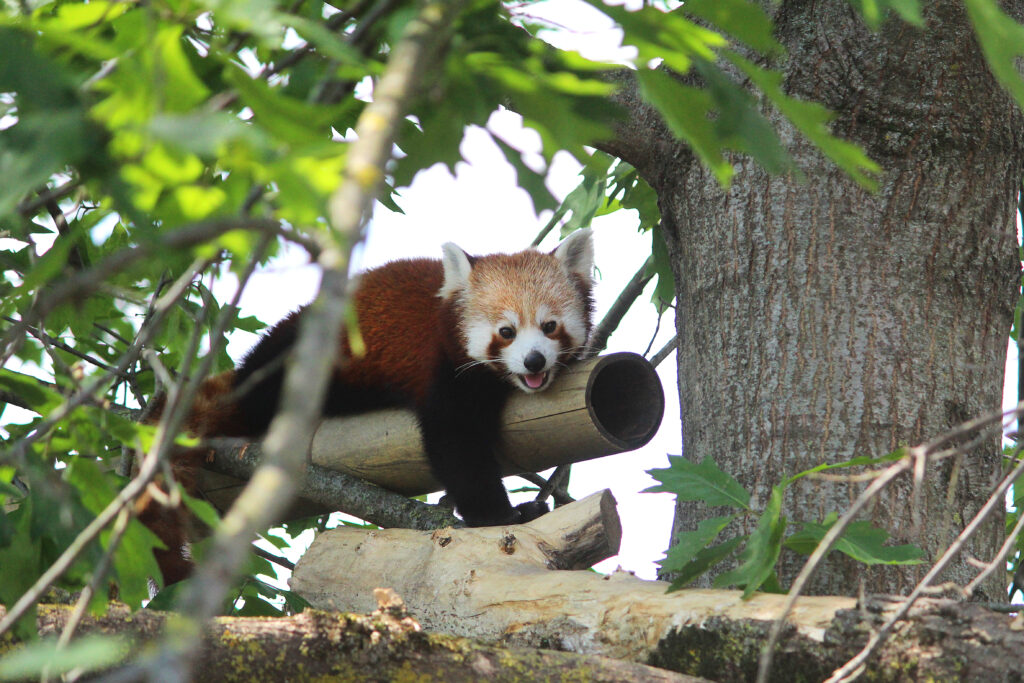
Haiku, the first red panda to arrive at Zoom Torino in 2015 and the father of the park’s most recent cub, died last week at the age of 12 due to age-related complications. Only one other red panda in Italy was older than him, by just one month.
His death marks the loss of an important individual for the European conservation programme for the red panda (Ailurus fulgens), a species classified as Endangered on the IUCN Red List after losing around half of its wild population over the past two decades.
“Haiku,” said Irene Carnovale, curator at Zoom Torino Biopark, “had three companions during his lifetime. His last partner, Suki, shared the final four years of his life, and together they had Tashi. Haiku was an excellent father. He allowed the mother and cub to maintain their exclusive bond inside the nest during the first months of the youngster’s life. Later, when Suki began taking Tashi on his first explorations, Haiku showed curiosity and interest in the cub, approaching him only as much as Suki allowed. And among the three of them, Haiku was always the first to wake up, exploring and patrolling the habitat while keeping watch over the territory.”
Beyond his contribution to breeding, Haiku also played an important role in scientific research. He participated in a behavioural study carried out by Openature Foundation in collaboration with the University of Turin, investigating paw preference in red pandas. The research found that, unlike the female, Haiku consistently used his left paw when descending from trees, a preference controlled by the right hemisphere of the brain and likely linked to visuospatial exploration, allowing him to better assess his surroundings while climbing down.
The red panda is a largely arboreal species that inhabits the temperate forests of the Himalayas, from Nepal to China. Through the presence of Haiku, Zoom Torino and its Openature Foundation also contributed to the conservation achievements of the Red Panda Network, which has restored 717 hectares of forest habitat by purchasing and rewilding private land in the districts of Panchthar, Ilam and Taplejung in eastern Nepal. A conservation effort that offers renewed hope for one of Asia’s most threatened mammals.