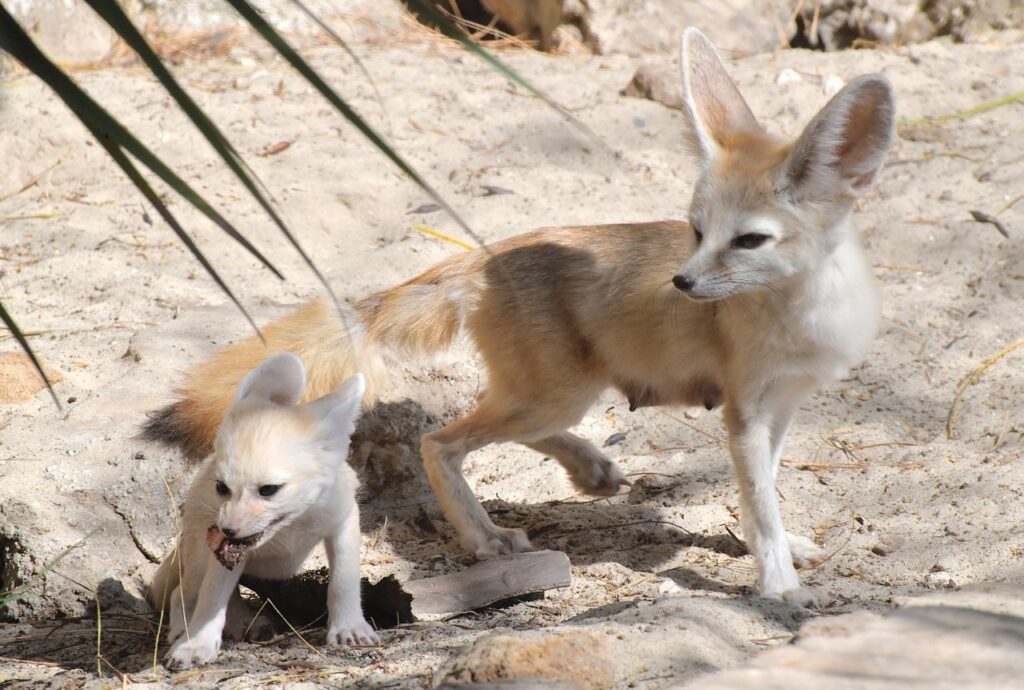
Five fennec fox (Vulpes zerda) pups have been born at Bioparco di Roma. Adults weigh just one kilogram, making them the world’s smallest canids, while their ears are the largest of any canid relative to body size.
“The kits are doing well,” said Paola Palanza, President of Bioparco di Roma, ethologist and Professor at the University of Parma. “At the moment, it is still too early to determine their sex.”
“The mother, Bella, is seven years old and was born here at Bioparco. The male, Rocco, is the same age and arrived at Bioparco in October 2025 from Kraków Zoo as part of the European Endangered Species Programme (EEP), dedicated to species conservation through population management, research and education within zoological institutions. The kits were born about one month ago inside a den dug by their parents in the soil or sand, just as they would be in the wild, where the family spends much of the daytime. The mother is nursing them and they have recently begun the weaning process. Fennecs are an extraordinary example of adaptation to desert environments: these small carnivores, closely related to foxes and other canids,” Palanza concluded, “have evolved unique characteristics that allow them to survive the extreme temperatures of the Sahara.”
The fennec inhabits sandy deserts and semi-arid regions across North Africa, from Western Sahara to Egypt. A territorial and monogamous species, breeding pairs live together with their offspring as a family group. Omnivorous by nature, fennecs feed on insects, lizards, birds, eggs, small rodents, fruits and tubers.
Their ears, which can reach 10 centimetres in length and account for around 20% of the animal’s body surface area, function as highly efficient thermal regulators, helping dissipate excess body heat while also providing exceptional hearing to detect prey moving beneath the sand.
The main threat facing fennecs is increasing human activity. Although legally protected in several countries, young animals are still captured illegally in some North African markets to be sold as pets or used as tourist photo props. Adults are also hunted for their fur, which is primarily used by local communities.