
What happens when chimpanzees can choose when to play music? And does a parrot’s preference for its left or right foot become more evident when it has to solve a problem?
Two studies conducted at Parco Natura Viva and led by Openature Foundation, the park’s research and conservation organisation, investigated animal behaviour by giving the animals themselves opportunities to make choices.
The findings were presented at Bioparco di Roma during the joint congress of the Italian Society of Ethology and the Italian Primatological Association.
The first study involved seven chimpanzees, while the second focused on 12 greater vasa parrots, producing findings that, according to the researchers, had not previously been documented in this species.
Chimpanzees could choose when to play music
In the first study, seven chimpanzees continued to move and interact within their normal social environment but were given an additional option: two ropes, one yellow and one blue, allowed them to voluntarily activate two different pieces of music with different rhythms.
The animals could approach the ropes, pull one and start the music themselves.
Researchers alternated two periods in which this sensory enrichment was available with two periods without music.
During the periods with music, the chimpanzees were generally more involved in social interactions. In particular, during the second period with musical enrichment, researchers recorded a significant increase in affiliative behaviours.
At that stage, all seven chimpanzees participated relatively evenly in the group’s social relationships, although individual differences remained in agonistic behaviours and dominance dynamics.
The findings therefore indicate that a musical enrichment which the animals can activate themselves may influence the social dynamics of the group.
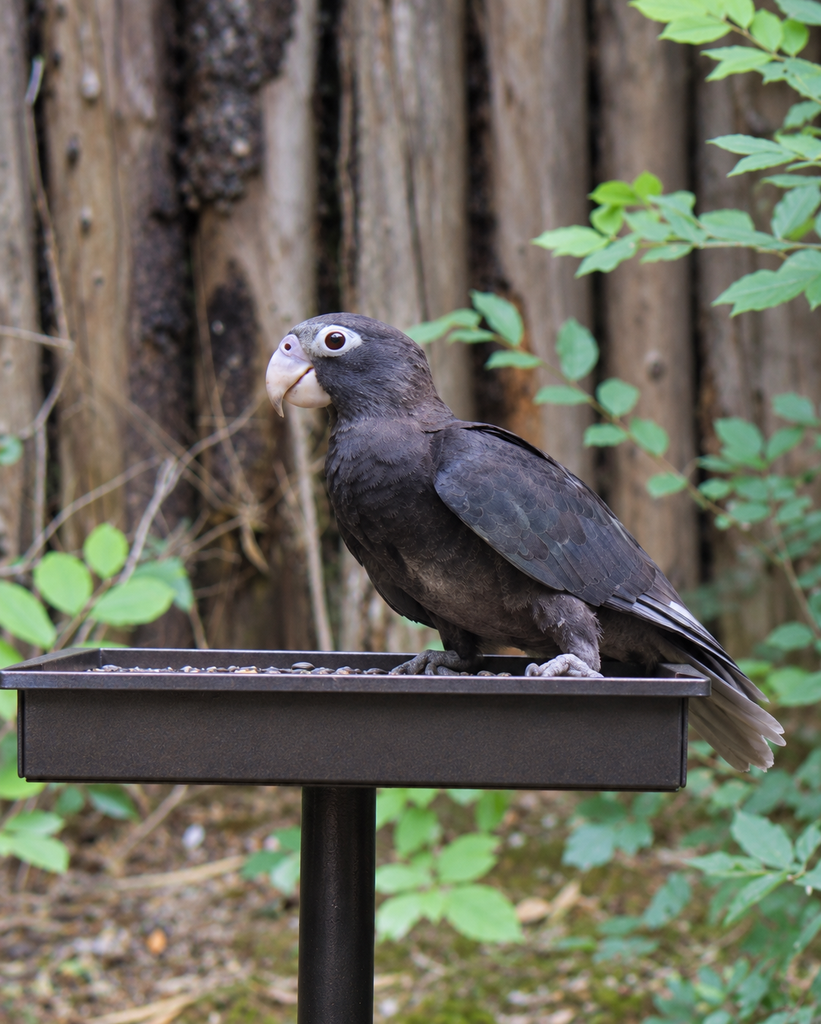
Left- or right-footed? The preference becomes clearer during problem solving
The second study followed 12 greater vasa parrots for three months, examining which foot they used during different behaviours and comparing spontaneous activities with more complex problem-solving tasks.
The researchers found that foot use varied according to the activity. When resting, the group predominantly used the left foot, while during object manipulation the right foot was more commonly used.
But the clearest pattern emerged as the tasks became more difficult. As complexity increased, so did the number of individuals showing significant lateralisation, with a more pronounced preference for using one foot rather than the other.
In other words, something resembling “right-footed” and “left-footed” individuals became more apparent when the parrots were faced with a problem to solve.
“Observing animals in their daily lives and while they make choices is one of the tools we have to understand how they perceive and deal with what surrounds them,” explains Caterina Spiezio, Head of Animal Research at Openature Foundation. “In these two studies, we worked on very different aspects: on the one hand, we observed how sensory enrichment can affect relationships within a complex social group such as chimpanzees; on the other, how the complexity of a task can more clearly reveal preferences in foot use in parrots. In both cases, it is the animals’ behaviour that provides us with information about their cognitive and social abilities. Enrichment thus becomes an opportunity for research through which we can acquire ever more tools to understand and protect the species in our care.”