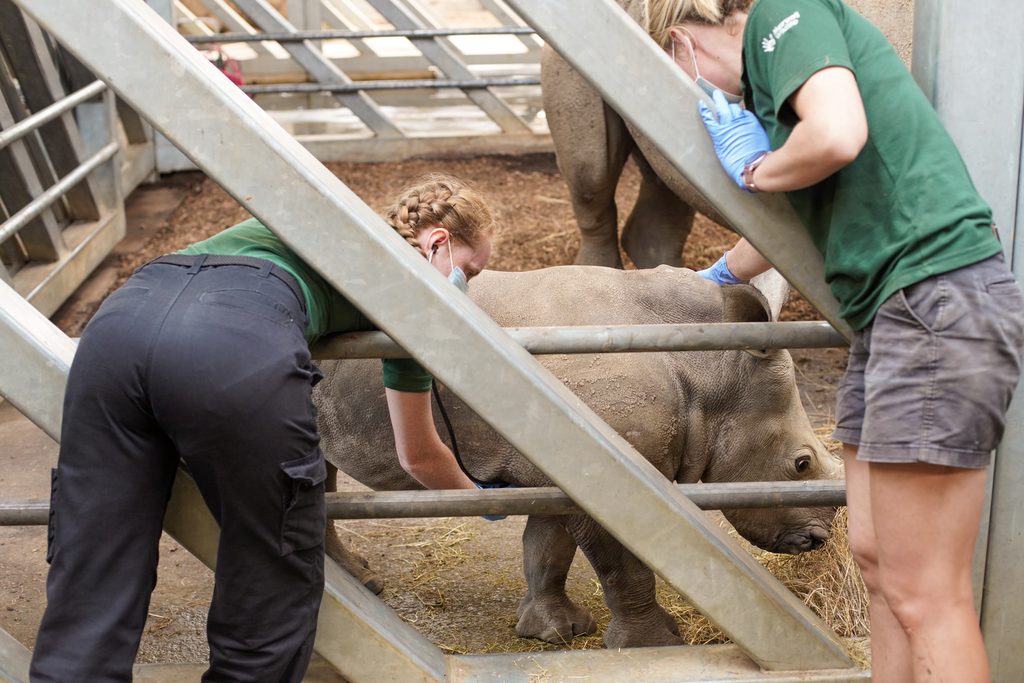
A life-threatening infection, more than two months of round-the-clock veterinary care and a treatment developed specifically for her have marked the first months of Amali, a southern white rhinoceros (Ceratotherium simum simum) calf born at Marwell Zoo in Hampshire, UK, on 15 March 2026.
After becoming critically ill with salmonellosis, Amali has now reached an important milestone in her recovery. She has been discharged from intensive care and is once again exploring the zoo’s main field alongside her mother, Zahra.
Her recovery is not yet complete. The calf continues to receive supplementary feeds and remains under close veterinary observation.
From digestive problems to a bloodstream infection
Amali appeared healthy at birth, but towards the end of May her keepers began noticing subtle changes in her behaviour.
She became quieter, less active and developed digestive problems.
“When you work with animals every day, you notice the smallest changes. As Amali became more uncomfortable, we knew something wasn’t right,” says Darren Ives, hoofstock keeper at Marwell Zoo.
Identifying the cause was challenging. Veterinary teams needed to collect diagnostic samples while minimising disruption to Amali and her mother, particularly during the early stages of their bond.
As her condition became increasingly concerning, Marwell sought advice from specialists at Liphook Equine Hospital.
Although horses and rhinoceroses look very different, they share several physiological characteristics, making the hospital’s expertise valuable in developing a treatment plan.
Further investigations confirmed that Amali had salmonellosis, a bacterial infection that can be carried by healthy adult animals without symptoms but can become fatal in young calves.
Amali developed severe diarrhoea and intestinal inflammation, resulting in substantial fluid and nutrient loss. Her digestive system was struggling to absorb the nutrition required for growth, and the infection had entered her bloodstream.
An innovative treatment combining two different probiotics
Amali required intensive supportive care, including hydration, pain relief, nutritional supplementation and treatment to help her digestive system recover.
One of the team’s priorities was to keep the calf with her mother throughout treatment, avoiding the additional welfare concerns that separation could have caused.
However, the situation became more complicated when Zahra developed mastitis, reducing her milk production.
Rather than hand-rearing Amali, the team introduced supplementary bottle feeds while allowing her to continue nursing from her mother.
Feeding quantities were adjusted according to her weight, hydration levels, milk intake and clinical progress.
Another challenge involved the beneficial bacteria in Amali’s digestive system, which had been disrupted by the infection.
Specialist probiotics developed for rhinoceroses are used by veterinary teams in South Africa, but the product needed for Amali was not available in the UK.
Dr Elysé Summerfield-Smith, Principal Vet at Marwell Zoo, researched the bacterial strains used in the South African formulation and compared dozens of probiotics available in Britain.
The result was an unusual, tailored combination: one human probiotic and one canine probiotic, selected to provide as close a match as possible to the beneficial bacteria Amali needed.
The treatment was developed with input from Liphook Equine Hospital and specialist rhinoceros experts in South Africa.
Back in the field with her mother
After more than two months of intensive care, Amali improved sufficiently to leave the intensive treatment programme.
“Amali is still receiving supplementary feeds and is still being closely monitored by our veterinary and hoofstock teams, so her recovery isn’t completely finished. But she’s making really encouraging progress,” says Dr Summerfield-Smith.
The young rhino can now be seen exploring the zoo’s main field alongside Zahra.
“There’s been a lot of emotional late nights and early mornings, dedicated teamwork and covering each other’s work within the team to support Amali’s recovery and each other but seeing her today, exploring in the field, following mum and behaving like a young rhino again, really has made it all worthwhile,” says Darren Ives.
Amali’s case highlights the complexity of veterinary care for young large mammals, particularly when treatment must address a serious illness while preserving the calf’s relationship with its mother and supporting its normal development.